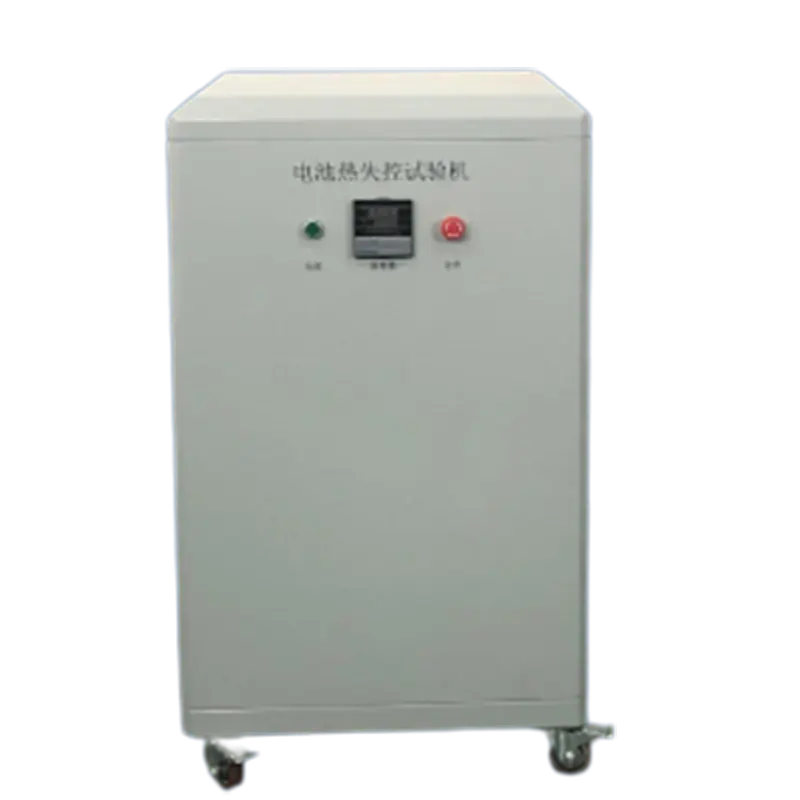
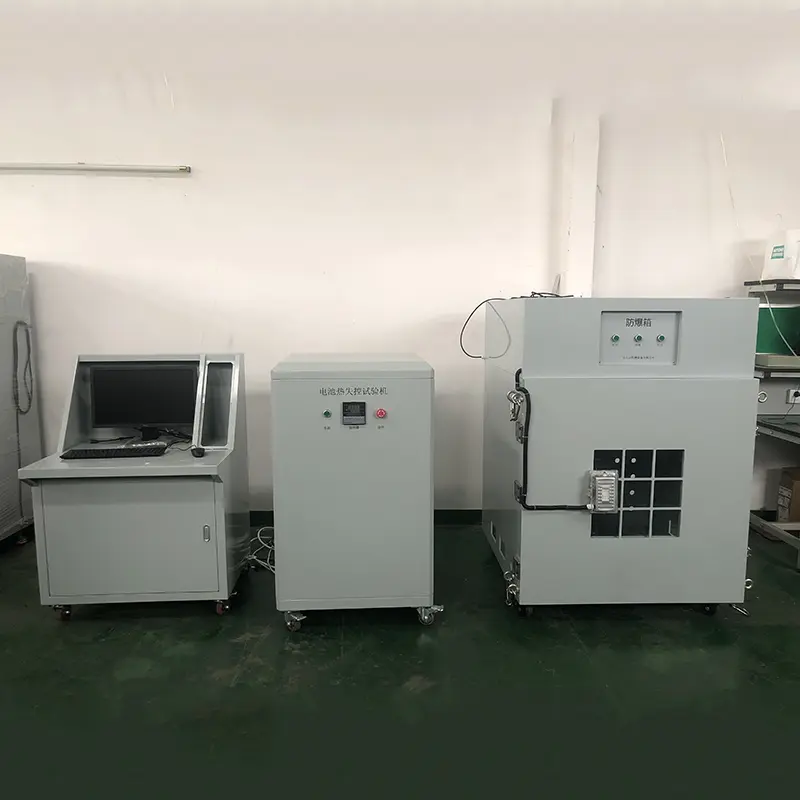
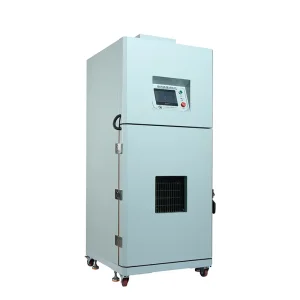
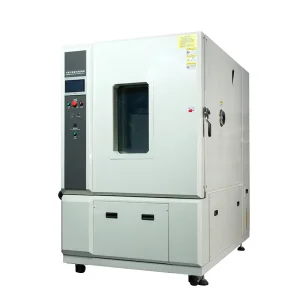
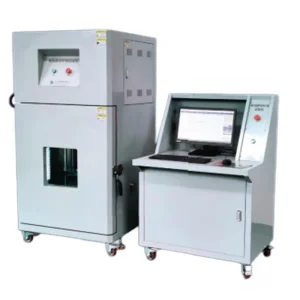
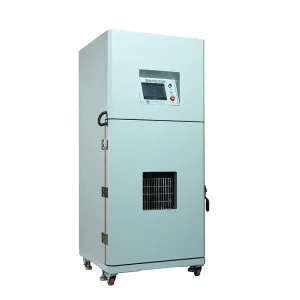
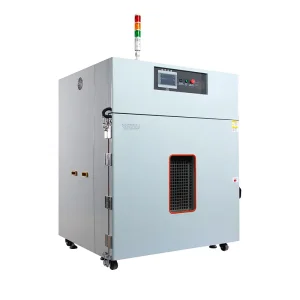
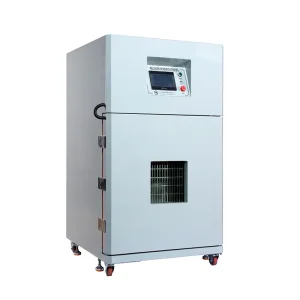
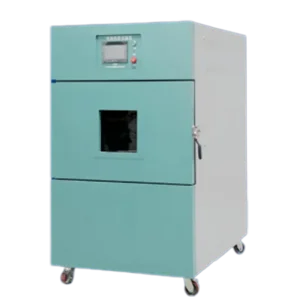
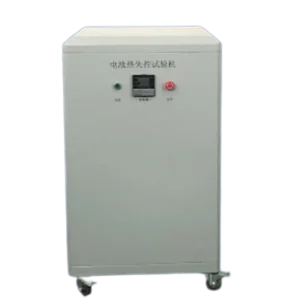
This high-precision device is integrated with advanced modules to ensure comprehensive safety testing for battery cells:
Heating System
Overcharge System
Temperature Acquisition System
Control System
Explosion-proof Protection
Video Surveillance System
2
Test Method & Requirements
1. Environmental Conditions: Experiments should be conducted at 25 ± 5 °C, with relative humidity of 15% to 90%, and atmospheric pressure of 86 kPa to 106 kPa.
2. Setup: Use flat or rod-shaped heating devices covered with ceramic, metal, or insulating layers. The heating device must be in direct contact with the battery. A temperature sensor (diameter < 1mm) should be placed on the opposite side of the heating source.
| Test Object Energy E (Wh) |
Max Power of Heating Device (W) |
| E < 100 |
30 ~ 300 |
| 100 ≤ E < 400 |
300 ~ 1000 |
| 400 ≤ E < 800 |
300 ~ 2000 |
| E ≥ 800 |
> 600 |
3. Procedure: After charging to 100% SOC, continue charging with 1C current for 12 minutes. Activate the heating device at max power. Stop when thermal runaway occurs or temperature reaches 300 °C.
4. Thermal Runaway Determination Criteria:
- Voltage drop in the test object.
- Monitoring point reaches the manufacturer's maximum operating temperature.
- Temperature rise rate (dT/dt) ≥ 1 °C/s.
Frequently Asked Questions (FAQ)
Q1: What is the main purpose of the Thermal Runaway Testing Machine?
A: It is designed to trigger and analyze thermal runaway in battery cells using overcharge and heating methods to evaluate safety performance.
Q2: How is the testing process controlled?
A: The system utilizes remote computer programming control combined with a high-definition video surveillance system for safe observation.
Q3: What are the criteria for identifying thermal runaway?
A: It is determined by a sudden voltage drop, reaching the maximum specified temperature, or a temperature rise rate of ≥ 1 °C/s.
Q4: Can the heating plate power be adjusted?
A: Yes, the system supports power progressive control (e.g., 50W/min to 500W/min) and is fully customizable based on the battery's energy capacity.
Q5: Is the data acquisition frequency suitable for high-speed testing?
A: Yes, both temperature and voltage acquisition channels operate at a frequency of 50Hz, ensuring precise data capture during rapid changes.
Q6: Are there safety protections for the testing equipment itself?
A: Absolutely. The machine includes protection against over-current, over-temperature, short circuits, and overloading, with an optional explosion-proof box.